
We looked at what people actually search for when they want to act in Quebec. It is almost always the same ten questions, in the same order, and most of the pages answering them promise a method instead of giving the answer.
Here are the answers. They are short because they are short: the industry is simpler than it looks, it is just badly documented. Each answer points to a full guide when the topic needs one.
1. Do you need a diploma to become an actor in Quebec?
No. No diploma is required. There is no professional order, no licence and no entrance exam.
Training is still the most common route, for a practical rather than a regulatory reason: it is where you learn to work fast with a text, and where the first networks form. A professional school, a conservatory or a private studio all lead to the same place. What opens doors afterwards is not the paper, it is what you can show. Our article on acting as a career explains how to go professional without a school.
2. Can you start without an agent?
Yes, and almost everyone does. The agent comes after the first roles, not before.
This is the industry’s costliest misunderstanding: many people wait to be represented before they start working, when agencies are looking precisely at what you have already shot. The usual order is the opposite of the one people imagine.
An agency does not sign “the good ones”. It signs the ones missing from its list, because it cannot put two people of the same profile forward for the same role.
3. What age can you start at?
Any age, and it is one of the few genuinely simple answers. The most frequent searches come from teenagers aged 13 to 16, but the Quebec industry is permanently looking for profiles of every age, and senior background work is one of the most in-demand segments.
Two concrete points for a minor: parental authorisation is required, and a serious agency never asks for money up front to represent a child.
4. The fastest route to a set: background work
If the goal is to be on a shoot within weeks, this is how. There is no school to finish and no agent to convince. You register yourself with the background casting companies, through an online form and a recent, accurate photo.
One nuance few guides mention: on a production covered by the UDA agreement, the first 25 background performers of each day must be UDA members. Non-members work beyond that number, on English-language productions shot in Quebec and on non-union productions. The main background casting companies in Montreal:
- FJB Casting (Figuration Julie Breton)
- MFK Casting, which took over the work of Figuration Carole Dionne
- Casting Quarters
- Montreal Casting
After that it is all about speed. Calls often go out the day before for the next morning and fill within hours. The photo has to look like you today, not three years ago: that is the first reason people are sent home from a set. Pay, union rules and what a day looks like are in our guide to becoming an extra in Quebec.
5. How do you get into a talent agency?
By writing to it directly, with recent photos, a one-page résumé and a demo reel or a self-tape. There is no secret form and no mandatory introduction.
The best moment to apply is when you already have something to show: projects you have shot, training you have finished, a first union contract. And a refusal almost never means “not good enough”: it means somebody with your profile is already on the list. Costs and red flags included, the full detail is in our guide to getting into a talent agency.
6. How do you choose between agencies in Montreal and Quebec City?
There is no “best talent agency”, and any list claiming otherwise is ranking companies on a criterion it does not disclose. Three questions you can check yourself in an hour, on the agencies’ own sites:
- Does it work in your field? Acting, modelling, youth and background work are four different jobs.
- Is somebody like you already on its public roster? If so your odds are thin, and it has nothing to do with your talent.
- How is it paid? A percentage of your fees, never a sum up front for an audition. It is the only criterion that is not a matter of taste.
7. Where are casting calls posted in Quebec?
Nowhere, in full. There is no official board where everything passes. Calls travel through five channels that do not see the same things:
- Talent agencies, which receive breakdowns directly from casting directors.
- Facebook casting and background groups: free, very active in Quebec, and unfiltered.
- North American profile platforms such as Casting Workbook and Actors Access, where you host your file.
- Public calls from productions and background agencies.
- Word of mouth and industry newsletters.
Without an agent, channels 2, 4 and 5 are the ones that stay open. They are also the most scattered, which is exactly why the next question keeps coming back.
8. Is there an app that gathers every casting call?
No. Any platform claiming so is describing its own catalogue. What exists falls into four families, and they do not replace each other:
- Profile platforms (Casting Workbook, Actors Access, Breakdown Services): you host your file there, and the agent submits.
- Subscription listings, such as Backstage: mostly American.
- Facebook groups: free, fast, and with no filtering at all.
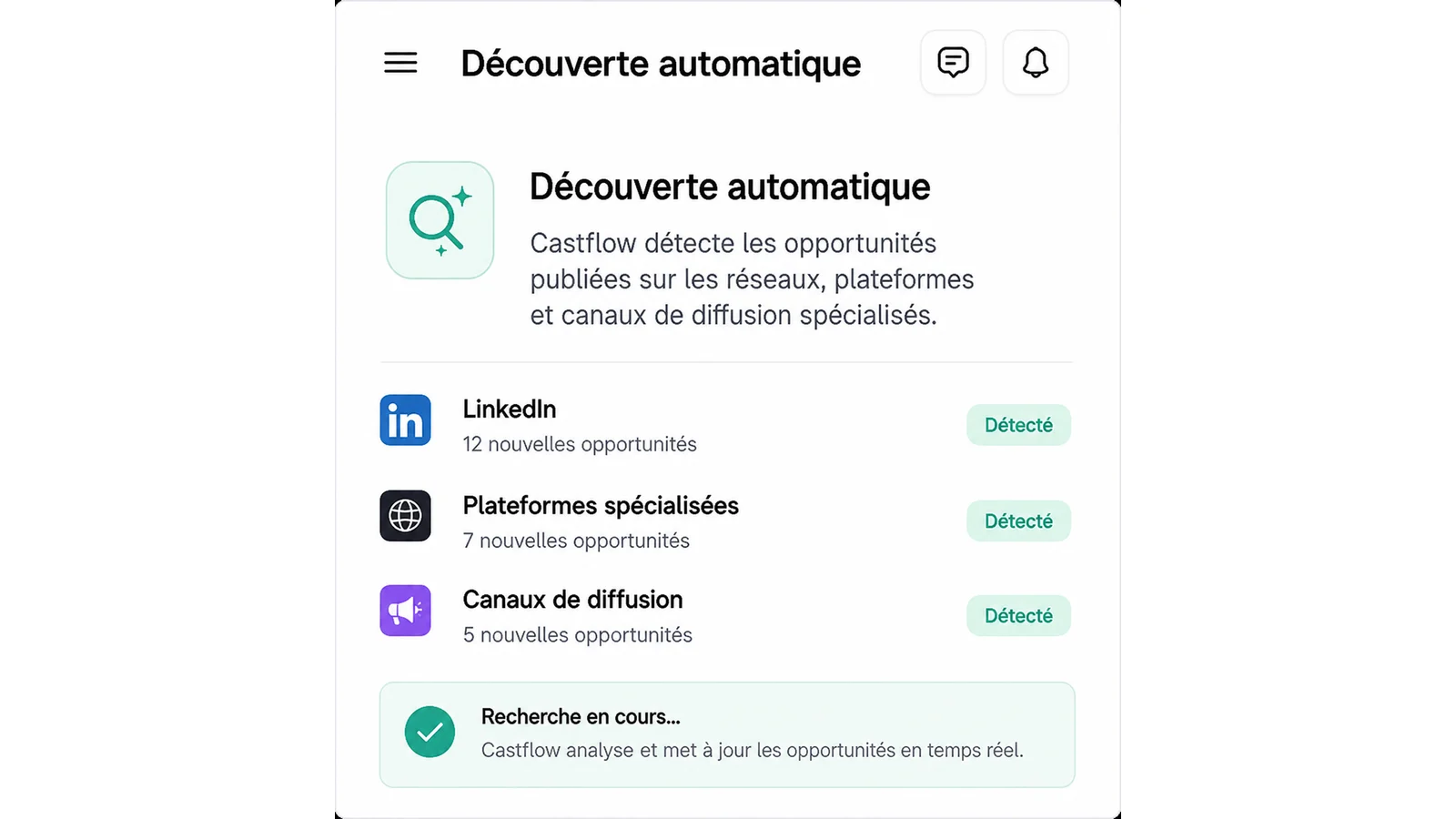
- Monitoring tools, which publish no roles but follow the existing channels and filter them.
The first family is how you get found. The fourth is how you find. An actor without an agent needs both, and it is the second one they are almost always missing.
9. How do you make a self-tape that does not get rejected?
A rejected self-tape is almost always rejected for a technical reason, never because the acting was not good enough. Three things are judged before the acting:
- Sound. A dead room (bedroom, curtains, rug) rather than a tiled living room, and the device less than two metres away.
- Light. A window facing you, never behind you: backlight turns a face into a silhouette.
- Framing. At eye level, from the chest with a little air above the head, in the orientation requested.
Add a reader off camera giving the lines more quietly than you, and name the file with your first name, last name, role and project. A file called IMG_4471.mov in a casting director’s inbox is a lost file. Gear, slate and mistakes to avoid are covered in our guide to making a good self-tape.
10. What about voice acting and dubbing?
Dubbing in Quebec is an actor’s job, not a voice. You do not get in with a nice voice or a demo recorded at home: you get in by being able to act truthfully, in sync, on the first read, and performer work there is reserved for active UDA members.
The usual route is acting training, then dubbing-specific training, then the auditions organised by Montreal studios. Voice-over and narration (advertising, documentary, audio guides, e-learning) are a neighbouring market, more open, where a well-treated home studio is often enough to start. Both routes are described in our guide to dubbing and voice-over.
So can anyone become an actor?
The question comes in ten different wordings, and the honest answer is: the door is closed to nobody, and nothing guarantees what follows. There is no gatekeeper. There is a job where the work starts before anyone pays you, and where the difference has less to do with raw talent than with the consistency of showing up where the roles travel.
What is genuinely rare is not talent. It is seeing the calls at the moment they go out. That is what Castflow for actors does: it follows published calls and only shows the ones that match your profile.